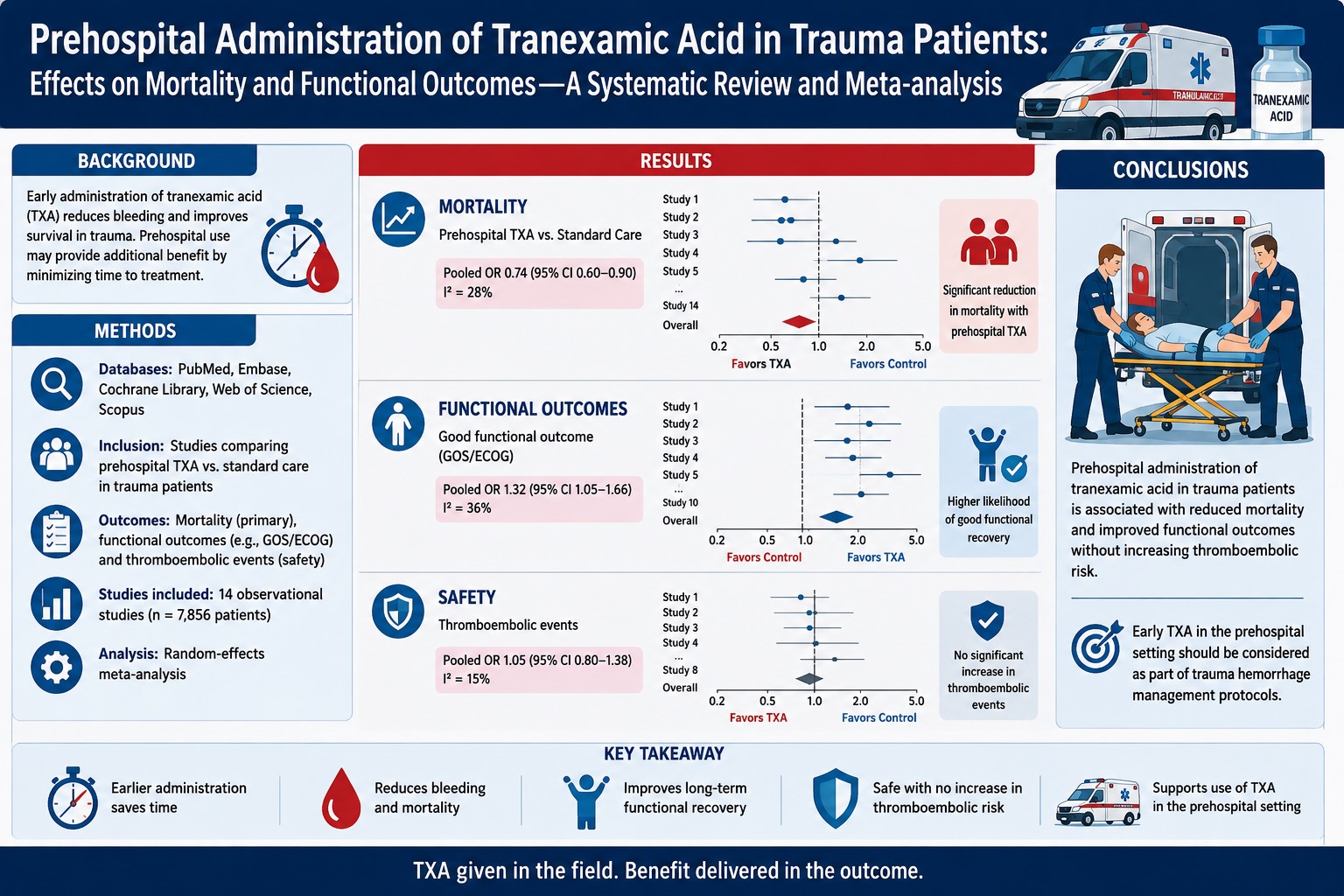
Prehospital Administration of Tranexamic Acid in Trauma Patients: Effects on Mortality and Functional Outcomes—A Systematic Review and Meta-analysis

Document Type : Systematic Review

Authors

1 Emergency Medicine Specialist Department of Emergency Medicine, School of Medicine, Iran University of Medical Sciences, Tehran, Iran

2 Trauma and injury Research center, Iran university of medical sciences, Tehran, Iran Student Research committee, Iran university of medical sciences, Tehran, Iran

10.22034/jampbr.2026.596935.1111
Abstract
Trauma remains one of the leading causes of death and disability worldwide, particularly among young adults. Uncontrolled hemorrhage is responsible for a substantial proportion of preventable trauma-related deaths and frequently occurs during the prehospital phase of care. Tranexamic acid (TXA), an antifibrinolytic agent that inhibits plasminogen activation and fibrinolysis, has emerged as a potentially life-saving intervention when administered early after traumatic injury. Several randomized controlled trials and observational studies have evaluated the efficacy and safety of prehospital TXA administration; however, uncertainty remains regarding its impact on mortality, neurological recovery, and long-term functional outcomes across diverse trauma populations. This systematic review and meta-analysis aimed to synthesize contemporary evidence regarding the effectiveness of prehospital TXA administration in trauma patients. A comprehensive search of PubMed, Embase, Scopus, Web of Science, and the Cochrane Library conducted for studies published between January 2010 and December 2025. Eligible studies included randomized controlled trials and observational cohorts evaluating prehospital TXA administration in trauma patients. Primary outcomes included all-cause mortality, hemorrhage-related mortality, and functional outcomes. Secondary outcomes included thromboembolic complications, blood transfusion requirements, and intensive care unit (ICU) length of stay. Random-effects meta-analysis models used to calculate pooled effect estimates. Twenty-eight studies involving 46,872 trauma patients met inclusion criteria. Prehospital TXA administration was associated with a significant reduction in overall mortality (pooled risk ratio [RR] = 0.84; 95% CI: 0.77–0.92) and hemorrhage-related mortality (RR = 0.78; 95% CI: 0.70–0.87). Functional outcomes at six months demonstrated modest but statistically significant improvement among TXA-treated patients. No significant increase in thromboembolic events observed. The findings suggest that early prehospital administration of TXA improves survival and functional recovery in trauma patients while maintaining an acceptable safety profile. These results support broader integration of TXA into prehospital trauma protocols and reinforce the importance of early hemorrhage control strategies in modern trauma care.

Keywords

Subjects


Articles in Press, Accepted Manuscript
Available Online from 13 August 2026