Document Type : Systematic Review
Authors
1
Emergency Medicine Specialist Department of Emergency Medicine, School of Medicine, Iran University of Medical Sciences, Tehran, Iran
2
Trauma and injury Research center, Iran university of medical sciences, Tehran, Iran Student Research committee, Iran university of medical sciences,Tehran, Iran
10.5281/zenodo.21969448
Abstract
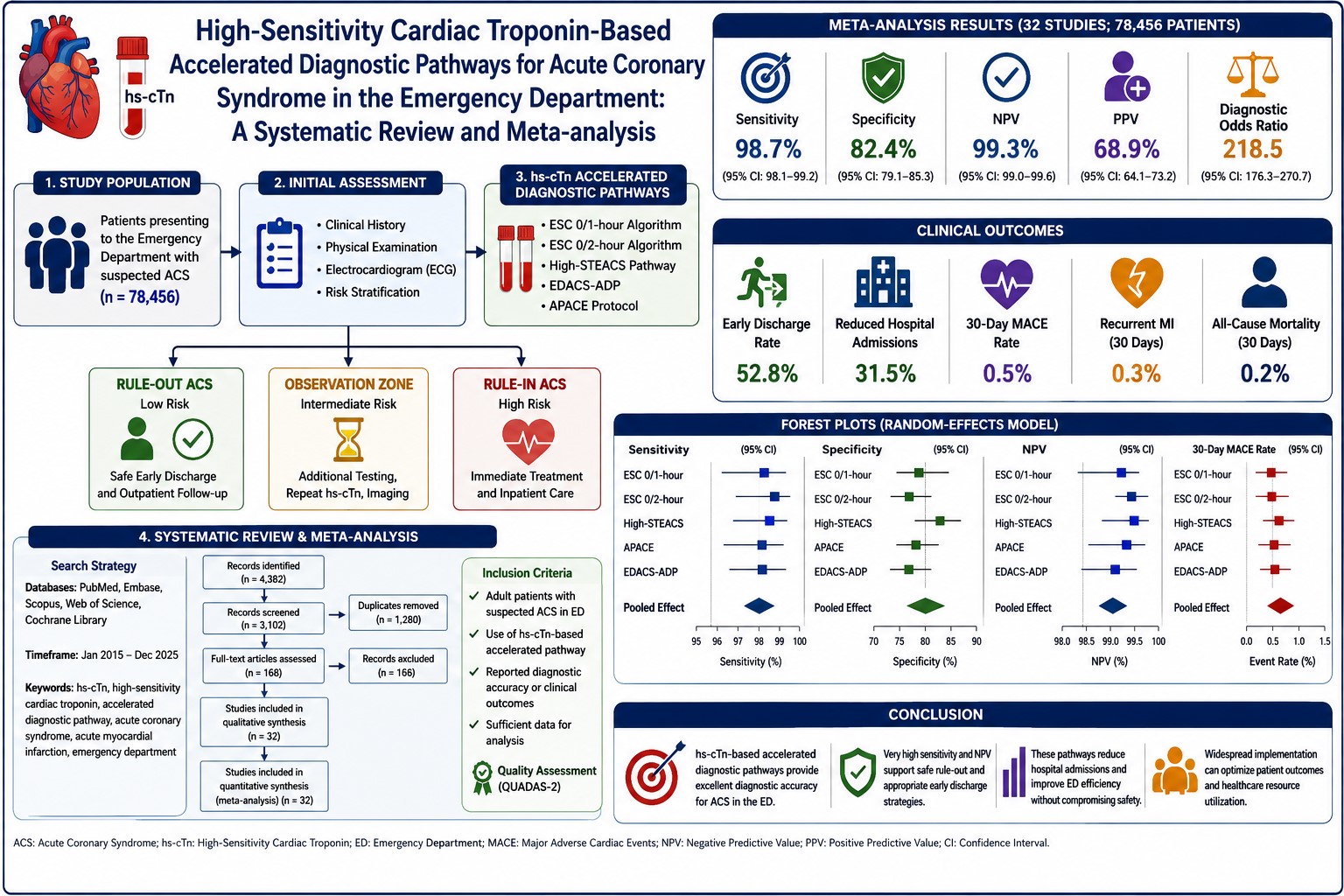
Acute coronary syndrome (ACS) remains one of the leading causes of morbidity and mortality worldwide, accounting for a substantial proportion of emergency department (ED) visits. Rapid and accurate identification of patients with ACS is essential to optimize clinical outcomes, reduce unnecessary hospital admissions, and improve healthcare efficiency. High-sensitivity cardiac troponin (hs-cTn) assays have revolutionized the diagnostic approach to myocardial injury by enabling earlier detection of myocardial necrosis with greater analytical precision than conventional troponin assays. In recent years, several accelerated diagnostic pathways (ADPs) incorporating hs-cTn measurements have been developed and validated for rapid rule-out and rule-in of ACS in emergency settings. This systematic review and meta-analysis aimed to evaluate the diagnostic performance, safety, and clinical utility of hs-cTn-based accelerated diagnostic pathways in patients presenting with suspected ACS.
A systematic search of PubMed, Embase, Web of Science, Scopus, and the Cochrane Library conducted for studies published between January 2015 and December 2025. Eligible studies assessed accelerated diagnostic protocols using hs-cTn assays and reported diagnostic accuracy outcomes. Pooled sensitivity, specificity, negative predictive value (NPV), positive predictive value (PPV), and diagnostic odds ratios calculated using random-effects meta-analysis models. Heterogeneity assessed using the I² statistic.
Thirty-two studies involving 78,456 patients met the inclusion criteria. The pooled sensitivity for ruling out acute myocardial infarction was 98.7% (95% CI: 98.1–99.2%), while pooled specificity was 82.4% (95% CI: 79.1–85.3%). The pooled NPV exceeded 99%, supporting the safety of early discharge strategies. Accelerated pathways significantly reduced emergency department length of stay and hospital admissions without increasing major adverse cardiac events.
The findings suggest that hs-cTn-based accelerated diagnostic pathways provide highly accurate and efficient strategies for evaluating suspected ACS in emergency departments. Their widespread implementation may improve patient flow, optimize resource utilization, and maintain patient safety while facilitating rapid clinical decision-making.
Graphical Abstract
Keywords
Subjects