Efficacy of Proximal Femoral Nail Antirotation (PFNA) in Managing Proximal Femoral Fractures: A Systematic Review of Short- and Long-Term Outcomes

Document Type : Systematic Review

Author

Assistant Professor of Orthopaedics, School of Medicine, Ardabil University of Medical Sciences. Ardabil. Iran

10.5281/zenodo.22816007
Abstract
Introduction: Proximal femoral fractures present significant biomechanical fixation challenges, particularly within osteoporotic bone. Although the Proximal Femoral Nail Antirotation (PFNA) provides theoretical rotational and load-sharing advantages via helical blade compaction, clinical evidence regarding sustained performance remains inconsistent. Therefore, this systematic review comprehensively evaluated the short- and long-term clinical, radiological, and functional outcomes of PFNA in proximal femoral fractures.

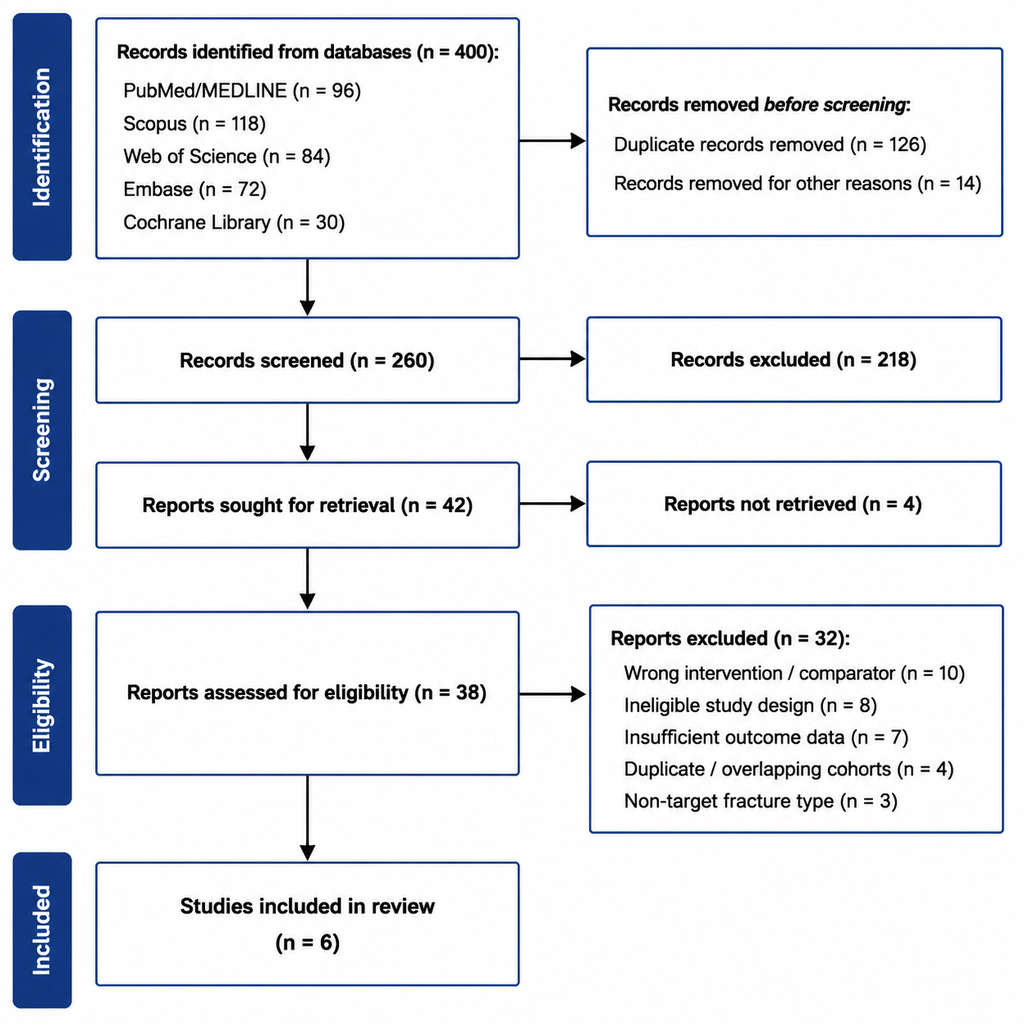
Material and methods: This systematic review followed PRISMA guidelines and searched PubMed/MEDLINE, Scopus, Web of Science, Embase, and the Cochrane Library without date restrictions. Randomized trials and prospective or retrospective observational studies evaluating PFNA for proximal femoral fractures were eligible. Two reviewers retrospective observational studies evaluating PFNA for proximal femoral fractures were eligible.

Results: Compared with extramedullary fixation, PFNA demonstrated superior union rates, reduced blood loss, and fewer mechanical failures, whereas comparisons with alternative cephalomedullary devices showed comparable clinical, functional, and complication profiles over 12 to8/9). Compared with extramedullary fixation, PFNA demonstrated superior union rates, reduced blood loss, and fewer mechanical failures, whereas comparisons with alternative cephalomedullary devices showed comparable clinical, functional, and complication profiles over 12 to 24 months of follow-up.

Conclusion: The available evidence indicates that PFNA is an effective and safe fixation modality for proximal femoral fractures, offering distinct biomechanical advantages over extramedullary implants and comparable efficacy to other cephalomedullary nails. Although complication rates remain clinically acceptable, high-quality, large-scale randomized trials are still needed to establish definitive superiority regarding long-term functional recovery and implant-specific morbidities across diverse patient cohorts.

Graphical Abstract

Efficacy of Proximal Femoral Nail Antirotation (PFNA) in Managing Proximal Femoral Fractures: A Systematic Review of Short- and Long-Term Outcomes

Keywords

Subjects

[1] Hessam, R and Milanifard, M. (2026). Clinical Performance of Wearable and Continuous Vital Sign Monitoring Technologies in Emergency Department Patients: A Systematic Review and Meta-analysis. Medicinal, Psychological, and Health Research Journal (MPHRJ), 2(6), 461-471.
[2] Kane, P. M., Vopat, B., Paller, D., Greenberg, P., & Born, C. (2013). Effect of distal interlock fixation in stable intertrochanteric fractures. Orthopedics, 36(7), e859–e864.
[3] Bonnaire, F., Zenker, H., Lill, C., Weber, A., & Spies, H. (2005). Treatment strategies for proximal femur fractures in osteoporotic patients. Osteoporosis International, 16(S2), S93–S102.
[4] Forte, M. L., Virnig, B. A., Kane, R. L., Durham, S., Bhandary, M., Mosenthal, A., … Wilt, T. J. (2008). Geographic variation in device use for intertrochanteric hip fractures. Journal of Bone and Joint Surgery (American Volume), 90(4), 691–699.
[5] Simmermacher, R. K., Ljungqvist, J., Bail, H., Hockertz, T., Vochteloo, A. J., Ochs, U., & Werken, C. (2008). The new proximal femoral nail antirotation (PFNA) in daily practice: Results of a multicentre clinical study. Injury, 39(8), 932–939.
[6] Mereddy, P., Kamath, S., Ramakrishnan, M., Malik, H., & Donnachie, N. (2009). The AO/ASIF proximal femoral nail antirotation (PFNA): A new design for the treatment of unstable proximal femoral fractures. Injury, 40(4), 428–432.
[7] Radcliff, T. A., Regan, E., Cowper Ripley, D. C., Hutt, E., & Maciejewski, M. L. (2012). Increased use of intramedullary nails for intertrochanteric proximal femoral fractures in veterans affairs hospitals: A comparative effectiveness study. Journal of Bone and Joint Surgery (American Volume), 94(9), 833–840.
[8] Kumar, R., Singh, R. N., & Singh, B. N. (2012). Comparative prospective study of proximal femoral nail and dynamic hip screw in treatment of intertrochanteric fracture femur. Journal of Clinical Orthopaedics and Trauma, 3(1), 28–36.
[9] Halder, S. C. (1992). The Gamma nail for peritrochanteric fractures. Journal of Bone and Joint Surgery (British Volume), 74(3), 340–344.
[10]             Davis, J., Harris, M. B., Duval, M., Detorie, F., Ziran, B., & Chao, E. Y. (1991). Peritrochanteric fractures treated with the Gamma nail: Technique and report of early results. Orthopedics, 14(9), 939–942.
[11]             Lindsey, R. W., Teal, P., Probe, R. A., Rhoads, D., & Davenport, S. (1991). Early experience with the gamma interlocking nail for peritrochanteric fractures of the proximal femur. Journal of Trauma, 31(12), 1649–1658.
[12]             Anglen, J. O., & Weinstein, J. N. (2008). Nail or plate fixation of intertrochanteric hip fractures: Changing pattern of practice. A review of the American Board of Orthopaedic Surgery Database. Journal of Bone and Joint Surgery (American Volume), 90(4), 700–707.
[13]             Adams, C. I., Robinson, C. M., Court-Brown, C. M., & McQueen, M. M. (2001). Prospective randomized controlled trial of an intramedullary nail versus dynamic screw and plate for intertrochanteric fractures of the femur. Journal of Orthopaedic Trauma, 15(6), 394–400.
[14]             Mokabber, N, Mokaber, M and Lotfi, A R. (2026). Effects of Dexmedetomidine on the Incidence of Agitation and Pain Severity after Traumatic Nasal Surgeries. Medicinal, Psychological, and Health Research Journal (MPHRJ), 2(6), 452-460.
[15]             Osnes, E. K., Lofthus, C. M., Falch, J. A., Meyer, H. E., & Kristiansen, I. S. (2001). More postoperative femoral fractures with the Gamma nail than the sliding screw plate in the treatment of trochanteric fractures. Acta Orthopaedica Scandinavica, 72(3), 252–256.
[16]             Hesse, B., & Gächter, A. (2004). Complications following the treatment of trochanteric fractures with the gamma nail. Archives of Orthopaedic and Trauma Surgery, 124(10), 692–698.
[17]              Güngör, S. (2026). The Efficacy of Cognitive Behavioral Therapy (CBT) in Treating Treatment-Resistant Depression: Mechanisms and Long-Term Outcomes. Medicinal, Psychological, and Health Research Journal (MPHRJ), 2(6), 438-451.
[18]             Min, W. K., Kim, S. Y., Kim, T. K., Lee, K. B., & Kim, K. H. (2007). Proximal femoral nail for the treatment of reverse obliquity intertrochanteric fractures compared with gamma nail. Journal of Trauma, 63(5), 1054–1060.
[19]             Seyed Hoseini, S V and Nasseri, A R. (2026). Identification of Predictive Factors for Late Radiotherapy Induced Complications in Post Mastectomy Breast Cancer Survivors. Medicinal, Psychological, and Health Research Journal (MPHRJ), 2(6), 409-418.
[20]             Seyed Hoseini, S V and Nasseri, A R. (2026). Clinical Significance of Preoperative Serum Albumin Levels in Predicting Survival After Surgery in Patients Undergoing Colorectal Cancer Resection. Medicinal, Psychological, and Health Research Journal (MPHRJ), 2(6), 419-428.
[21]             Skála-Rosenbaum, J., Bartnick, J., & Bartoska, R. (2010). Is distal locking with IMHN necessary in every peritrochanteric fracture? International Orthopaedics, 34(7), 1041–1047.
[22]             Li, X., Zhang, L., Hou, Z., & Zhang, Y. (2015). Distal locked and unlocked nailing for perthrochanteric fractures—A prospective comparative randomized study. International Orthopaedics, 39(8), 1645–1652.
[23]             Caiaffa, V., Vicenti, G., Mori, C., Panella, A., Conserva, V., & Moretti, B. (2016). Is distal locking with short intramedullary nails necessary in stable peritrochanteric fractures? A prospective, multicentre, randomized study. Injury, 47(Suppl 4), S98–S106.
[24]             Lanzetti, R. M., Caraffa, A., Lupariello, D., Ceccarini, P., Gambaracci, G., & Antinolfi, P. (2018). Comparison between locked and unlocked intramedullary nails in intertrochanteric fractures. European Journal of Orthopaedic Surgery & Traumatology, 28(4), 649–658.
[25]             Rosenblum, S. F., Zuckerman, J. D., Kummer, F. J., & Frankel, V. H. (1992). A biomechanical evaluation of the Gamma nail. Journal of Bone and Joint Surgery (British Volume), 74(3), 352–357.
[26]             Ciaffa, V., Vicenti, G., Mori, C. M., Panella, A., Conserva, V., & Moretti, B. (2018). Unlocked versus dynamic and static distal locked femoral nails in stable and unstable intertrochanteric fractures. A prospective study. Injury, 49(Suppl 4), S19–S25.
[27]             Heinz, T., & Vécsei, V. (1994). Complications and errors in use of the gamma nail: Causes and prevention. Chirurg, 65(11), 943–952.
[28]             Stapert, J. W., Geesing, C. L., Jacobs, P. B., de Wit, R. J., & Vierhout, P. A. (1993). First experience and complications with the long Gamma nail. Journal of Trauma, 34(3), 394–400.
[29]             Bishnoi, M., Kirmani, T. T., Huda, N., & Shankar, V. (2018). Epidemiological analysis of hip fractures at a tertiary care center: A retrospective study. International Journal of Research in Orthopaedics, 4(3), 568.
[30]             Avulapati, S. K., Bajjuri, A., Boddu, S., & Reddy, V. (2020). Mortality and morbidity of proximal femur fractures in elderly population: A three-year follow-up study. Indian Journal of Orthopaedic Surgery, 6(2), 69–72.
[31]             Chouhan, D., Meena, S., Kamboj, K., & Sharma, P. (2020). Distal locked versus unlocked intramedullary nailing in intertrochanteric fracture: A systematic review and meta-analysis of randomized and non-randomized trials. Bulletin of Emergency and Trauma, 8(2), 56–61.
[32]             Li, Y. H., Yu, T., Shao, W., Liu, Y., & Zhu, Y. (2020). Distal locked versus unlocked intramedullary nailing for stable intertrochanteric fractures: A systematic review and meta-analysis. BMC Musculoskeletal Disorders, 21(1), 461.
[33]             Vopat, B. G., Kane, P. M., Truntzer, J., Bariteau, J. T., & Born, C. T. (2014). Is distal locking of long nails for intertrochanteric fractures necessary? A clinical study. Journal of Clinical Orthopaedics and Trauma, 5(4), 233–239.
[34]             Boraiah, S., Barker, J. U., & Lorich, D. (2009). Efficacy of an aiming device for the placement of distal interlocking screws in trochanteric fixation nailing. Archives of Orthopaedic and Trauma Surgery, 129(9), 1177–1182.
[35]             Macario, A. (2010). What does one minute of operating room time cost? Journal of Clinical Anesthesia, 22(4), 233–236.
[36]             Yun, H. H., Yoon, J. R., Seo, H. S., & Kim, Y. S. (2015). Is distal locking constantly necessary when intertrochanteric femur fracture is stably fixed in the distal area with intramedullary hip nail? Journal of the Korean Orthopaedic Association, 50(1), 8.