Platelet Count as a Prognostic Marker for Local Recurrence in Surgically Resectable Head and Neck Squamous Cell Carcinoma: A Pathological Analysis

Document Type : Original Article

Authors

1 Assistant Professor of Neurosurgery, Department of Neurosurgery, School of Medicine, Tabriz University of Medical Sciences, Tabriz, Iran

2 Associate Professor of Pathology, Department of Pathology, School of Medicine, Tabriz University of Medical Sciences, Tabriz, Iran

10.5281/zenodo.23125908
Abstract
Introduction: Head and neck squamous cell carcinoma (HNSCC) remains burdened by high local recurrence rates, severely limiting long-term survival. Emerging evidence suggests that platelet-mediated systemic inflammation and angiogenesis facilitate residual tumor progression. This study evaluates the prognostic significance of preoperative platelet count as an independent predictor of local recurrence in patients undergoing curative-intent surgical resection for HNSCC.

Material and methods: This descriptive cross-sectional study, conducted at Shohada Hospital, Tabriz, enrolled 74 patients with surgically resectable head and neck squamous cell carcinoma using convenience sampling. Clinical and pathological data were systematically extracted to evaluate the prognostic significance of preoperative platelet count regarding local recurrence. Statistical comparisons and logistic regression were utilized to identify independent predictors, ensuring full adherence to established ethical standards.

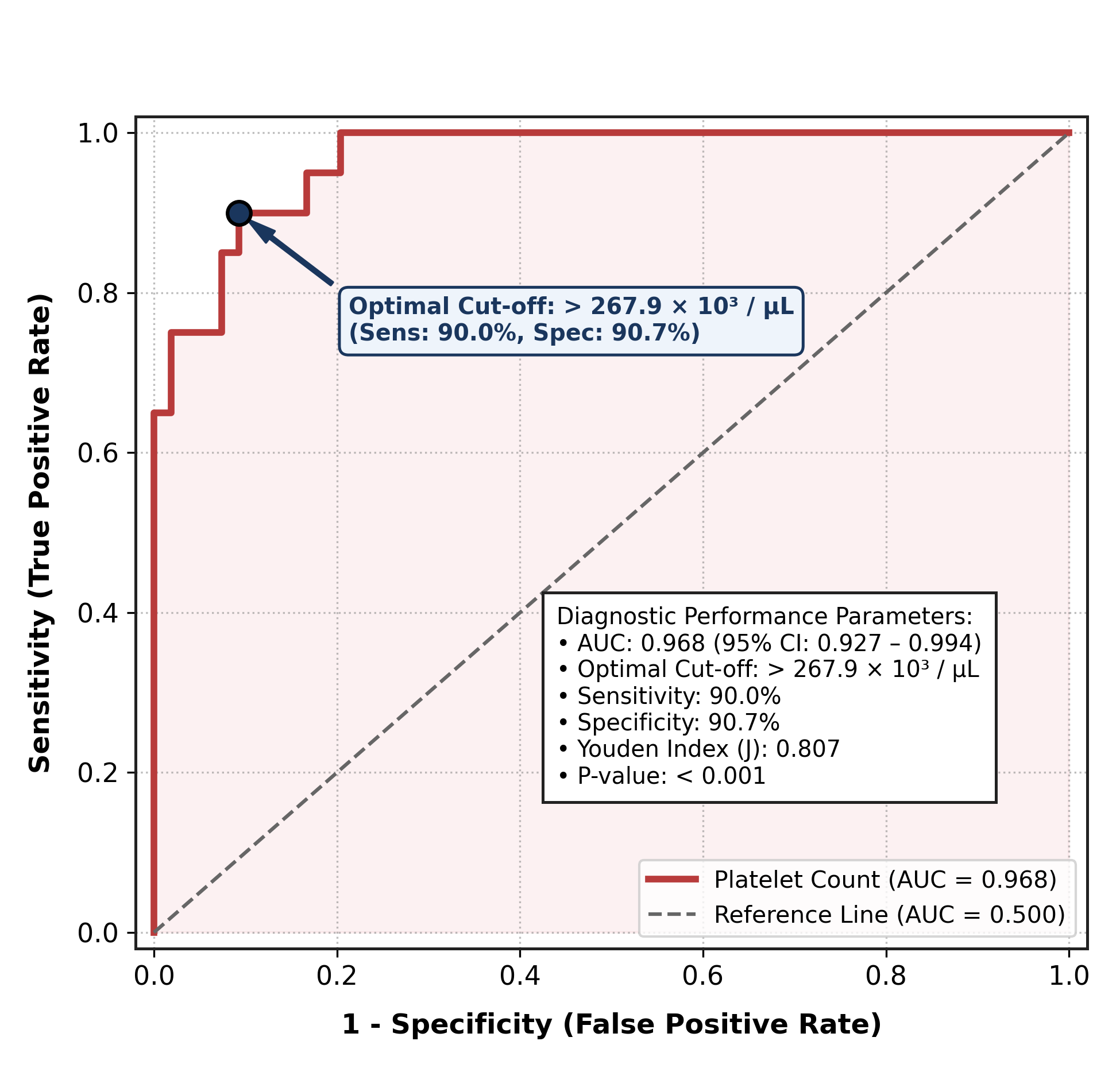
Results: Preoperative thrombocytosis significantly correlated with local recurrence (336.5 vs. 230.7×10³ / µL; P<0.001). ROC analysis confirmed robust predictive accuracy (AUC 0.968; Sensitivity 90.0%; Specificity 90.7%) at an optimal cut-off of>267.9×10³/µL. Furthermore, multivariable logistic regression identified elevated platelet count as an independent predictor of local disease failure, even after adjusting for established clinicopathological variables (adjusted odds ratio [aOR] 3.42; 95% CI:1.12–10.45; P=0.031).

Conclusion: Baseline preoperative platelet count serves as a potent, noninvasive, and independent prognostic biomarker for predicting local recurrence in surgically resectable head and neck squamous cell carcinoma. Routine assessment of this hematological parameter may enhance patient stratification and guide postoperative surveillance strategies, potentially improving oncological outcomes.

Graphical Abstract

Platelet Count as a Prognostic Marker for Local Recurrence in Surgically Resectable Head and Neck Squamous Cell Carcinoma: A Pathological Analysis

Keywords

Subjects

[1]       Chen, W., Zheng, R., Baade, P. D., Zhang, S., Zeng, H., Bray, F., Jemal, A., Yu, X. Q., & He, J. (2016). Cancer statistics in China, 2015. CA: A Cancer Journal for Clinicians, 66(2), 115–132.
[2]       Schorn, V. J., & Miles, B. A. (2014). Laryngeal squamous cell carcinoma. Springer.
[3]       Santos, T. S., Estevão, R., Antunes, L., Certal, V., Silva, J. C., & Monteiro, E. (2016). Clinical and histopathological prognostic factors in locoregional advanced laryngeal cancer. The Journal of Laryngology & Otology, 130(10), 948–953.
[4]       Siegel, R., Ma, J., Zou, Z., & Jemal, A. (2014). Cancer statistics, 2014. CA: A Cancer Journal for Clinicians, 64(1), 9–29.
[5]       Hoffman, H. T., Porter, K., Karnell, L. H., Cooper, J. S., Weber, R. S., Langer, C. J., Ang, K. K., Gay, G., Stewart, A., & Robinson, R. A. (2006). Laryngeal cancer in the United States: Changes in demographics, patterns of care, and survival. The Laryngoscope, 116(9 Pt. 2 Suppl. 111), 1–13.
[6]       Balch, C. M., Soong, S.-J., Gershenwald, J. E., Thompson, J. F., Reintgen, D. S., Cascinelli, N., Urist, M., McMasters, K. M., Ross, M. I., Kirkwood, J. M., Atkins, M. B., Thompson, J. A., Coit, D. G., Byrd, D., Desmond, R., Zhang, Y., Liu, P.-Y., & Lyman, G. H. (2001). Prognostic factors analysis of 17,600 melanoma patients: Validation of the American Joint Committee on Cancer melanoma staging system. Journal of Clinical Oncology, 19(16), 3622–3634.
[7]       Grivennikov, S. I., Greten, F. R., & Karin, M. (2010). Immunity, inflammation, and cancer. Cell, 140(6), 883–899.
[8]       Valero, C., Pardo, L., López, M., García, J., & others. (2017). Pretreatment count of peripheral neutrophils, monocytes, and lymphocytes as independent prognostic factor in patients with head and neck cancer. Head & Neck, 39(2), 219–226.
[9]       Wang, J., Wang, S., Song, X., Zeng, W., Zeng, Q., Yang, J., Chen, J., & Liu, W. (2016). The prognostic value of systemic and local inflammation in patients with laryngeal squamous cell carcinoma. OncoTargets and Therapy, 9, 7177–7185.
[10]    Kara, M., Uysal, S., Altınışık, U., Cevizci, S., Güçlü, O., & Dereköy, F. S. (2017). The pre-treatment neutrophil-to-lymphocyte ratio, platelet-to-lymphocyte ratio, and red cell distribution width predict prognosis in patients with laryngeal carcinoma. European Archives of Oto-Rhino-Laryngology, 274(1), 535–542.
[11]    Lorente, D., Mateo, J., Templeton, A. J., Zafeiriou, Z., Bianchini, D., Ferraldeschi, R., Souness, R., Smith, M., Dearnaley, D., & de Bono, J. S. (2015). Baseline neutrophil-lymphocyte ratio (NLR) is associated with survival and response to treatment with second-line chemotherapy for advanced prostate cancer independent of baseline steroid use. Annals of Oncology, 26(4), 750–755.
[12]    Dilek, U., Celalettin, E., Neslihan, K., et al. (2013). Are neutrophil/lymphocyte and platelet/lymphocyte rates in patients with non-small cell lung cancer associated with treatment response and prognosis? Asian Pacific Journal of Cancer Prevention, 14(9), 5237–5242.
[13]    Choi, W. J., Cleghorn, M. C., Jiang, H., Jackson, T. D., Okrainec, A., & Quereshy, F. A. (2015). Preoperative neutrophil-to-lymphocyte ratio is a better prognostic serum biomarker than platelet-to-lymphocyte ratio in patients undergoing resection for nonmetastatic colorectal cancer. Annals of Surgical Oncology, 22(Suppl. 3), S603–S613.
[14]    Kano, S., Homma, A., Hatakeyama, H., Mizumachi, T., Sakashita, T., Kano, K., et al. (2017). Pretreatment lymphocyte-to-monocyte ratio as an independent prognostic factor for head and neck cancer. Head & Neck, 39(2), 247–253.
[15]    Tu, X. P., Qiu, Q. H., Chen, L. S., Luo, X. N., Lu, Z. M., Zhang, S. Y., et al. (2015). Preoperative neutrophil-to-lymphocyte ratio is an independent prognostic marker in patients with laryngeal squamous cell carcinoma. BMC Cancer, 15, 743.
[17]    Edge, S. B., & Compton, C. C. (2010). The American Joint Committee on Cancer: The 7th edition of the AJCC cancer staging manual and the future of TNM. Annals of Surgical Oncology, 17(6), 1471–1474.
[18]    Strieter, R. M., Burdick, M. D., Mestas, J., Gomperts, B., Keane, M. P., & Belperio, J. A. (2006). Cancer CXC chemokine networks and tumour angiogenesis. European Journal of Cancer, 42(6), 768–778.
[19]    Grosse-Steffen, T., Giese, T., Giese, N., Longerich, T., Schirmacher, P., Hänsch, G. M., & Gaida, M. M. (2012). Epithelial-to-mesenchymal transition in pancreatic ductal adenocarcinoma and pancreatic tumor cell lines: The role of neutrophils and neutrophil-derived elastase. Clinical & Developmental Immunology, 2012, 720768.
[20]    Gaida, M. M., Steffen, T. G., Günther, F., Tschaharganeh, D. F., Felix, K., Bergmann, F., Schirmacher, P., & Hänsch, G. M. (2012). Polymorphonuclear neutrophils promote dyshesion of tumor cells and elastase-mediated degradation of E-cadherin in pancreatic tumors. European Journal of Immunology, 42(12), 3369–3380.