Association Between Preoperative Serum Prostate-Specific Antigen Levels and Gleason Score in Patients Undergoing Radical Prostatectomy for Prostate Adenocarcinoma

Document Type : Original Article

Authors

1 Honours Health Sciences Program, McMaster University, Hamilton, Ontario, Canada

2 Assistant Professor of Pathology, Department of Pathology, School of Medicine, Tabriz University of Medical Sciences, Tabriz, Iran

10.22034/jampbr.2026.605443.1135
Abstract
Introduction: Prostate cancer risk stratification relies heavily on preoperative serum prostate-specific antigen (PSA) levels and definitive histopathological grading. Although these metrics are fundamental to surgical decision-making, the consistency of their relationship warrants ongoing validation. Therefore, this study aims to assess the association between preoperative serum prostate-specific antigen levels and Gleason score in patients undergoing radical prostatectomy for prostate adenocarcinoma.

Material and methods: This cross-sectional study at Imam Reza Hospital, Tabriz, enrolled 120 patients via convenience sampling. We evaluated the correlation between preoperative serum prostate-specific antigen (PSA) levels and histopathological Gleason scores in men undergoing radical prostatectomy for adenocarcinoma. Clinical and pathological data were retrospectively collected from medical records, and appropriate statistical analyses were performed to determine the association between these variables.

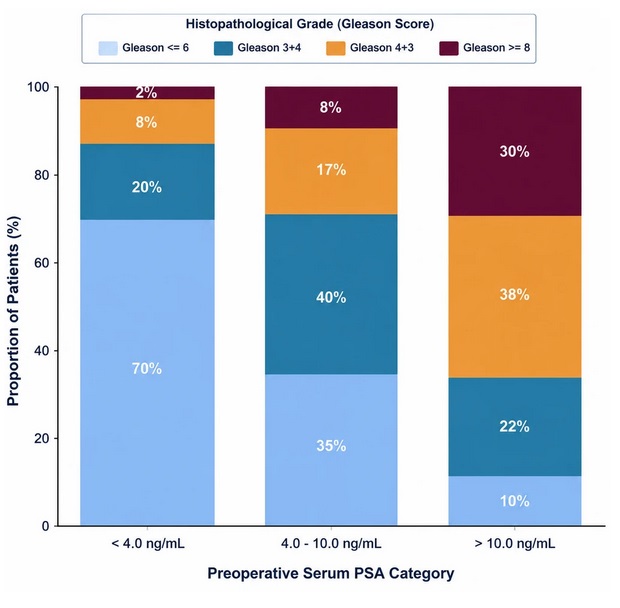
Results: In this cohort of 120 patients, preoperative serum PSA demonstrated a significant positive linear correlation with radical prostatectomy Gleason scores (r=0.58, P<0.001). Receiver operating characteristic curve analysis confirmed strong discriminative capacity for high-grade disease (AUC=0.84), identifying an optimal predictive cut-off of 10.2 ng/mL (sensitivity 81.5%, specificity 76.8%). Furthermore, higher PSA tiers consistently corresponded to an increased proportional distribution of aggressive pathological histotypes compared to lower biomarker categories.

Conclusion: Preoperative serum PSA serves as a reliable, non-invasive biomarker for histological risk stratification in patients undergoing radical prostatectomy. Given its strong association with adverse Gleason scores and high discriminative diagnostic accuracy, preoperative PSA levels effectively identify candidates requiring intensified oncological evaluation.

Graphical Abstract

Association Between Preoperative Serum Prostate-Specific Antigen Levels and Gleason Score in Patients Undergoing Radical Prostatectomy for Prostate Adenocarcinoma

Keywords

Subjects

[1]             Miller, K. D., Nogueira, L., Mariotto, A. B., Rowland, J. H., Yabroff, K. R., Alfano, C. M., Jemal, A., Kramer, J. L., & Siegel, R. L. (2019). Cancer treatment and survivorship statistics, 2019. CA: A Cancer Journal for Clinicians, 69(5), 363–385.
[2]             Labrie, F., Dupont, A., Simard, J., Luu-The, V., & Bélanger, A. (1993). Intracrinology: The basis for the rational design of endocrine therapy at all stages of prostate cancer. European Urology, 24(Suppl. 2), 94–105.
[3]             Montgomery, R. B., Mostaghel, E. A., Vessella, R., Hess, D. L., Kalhorn, T. F., Higano, C. S., True, L. D., & Nelson, P. S. (2008). Maintenance of intratumoral androgens in metastatic prostate cancer: A mechanism for castration-resistant tumor growth. Cancer Research, 68(11), 4447–4454.
[4]             Barnard, M., Mostaghel, E. A., Auchus, R. J., & Storbeck, K.-H. (2020). The role of adrenal derived androgens in castration resistant prostate cancer. Journal of Steroid Biochemistry and Molecular Biology, 197, 105506.
[5]             Mostaghel, E. A. (2014). Beyond T and DHT—Novel steroid derivatives capable of wild type androgen receptor activation. International Journal of Biological Sciences, 10(6), 602–613.
[6]             Mostaghel, E. A., & Nelson, P. S. (2008). Intracrine androgen metabolism in prostate cancer progression: Mechanisms of castration resistance and therapeutic implications. Best Practice & Research Clinical Endocrinology & Metabolism, 22(2), 243–258.
[7]             Pretorius, E., Africander, D. J., Vlok, M., Perkins, M. S., Quanson, J., & Storbeck, K.-H. (2016). 11-Ketotestosterone and 11-ketodihydrotestosterone in castration resistant prostate cancer: Potent androgens which can no longer be ignored. PLoS ONE, 11(7), e0159867.
[8]             Schiffer, L., Arlt, W., & Storbeck, K.-H. (2018). Intracrine androgen biosynthesis, metabolism and action revisited. Molecular and Cellular Endocrinology, 465, 4–26.
[9]             Turcu, A. F., & Auchus, R. J. (2017). Clinical significance of 11-oxygenated androgens. Current Opinion in Endocrinology, Diabetes and Obesity, 24(3), 252–259.
[10]          Barnard, L., du Toit, T., & Swart, A. C. (2021). Back where it belongs: 11β-hydroxyandrostenedione compels the re-assessment of C11-oxy androgens in steroidogenesis. Molecular and Cellular Endocrinology, 525, 111189.
[11]          Barnard, M., Quanson, J. L., Mostaghel, E., Pretorius, E., Snoep, J. L., & Storbeck, K.-H. (2018). 11-Oxygenated androgen precursors are the preferred substrates for aldo-keto reductase 1C3 (AKR1C3): Implications for castration resistant prostate cancer. Journal of Steroid Biochemistry and Molecular Biology, 183, 192–201.
[12]          Caron, P., Turcotte, V., & Guillemette, C. (2021). A quantitative analysis of total and free 11-oxygenated androgens and its application to human serum and plasma specimens using liquid-chromatography tandem mass spectrometry. Journal of Chromatography A, 1650, 462228.
[13]          Storbeck, K.-H., Bloem, L. M., Afrikander, D., Schloms, L., Swart, P., & Swart, A. C. (2013). 11β-Hydroxy dihydrotestosterone and 11-ketodihydrotestosterone, novel C19 steroids with androgenic activity: A putative role in castration resistant prostate cancer? Molecular and Cellular Endocrinology, 377(1–2), 135–146.
[14]          du Toit, T., & Swart, A. C. (2018). Inefficient UGT-conjugation of adrenal 11β-hydroxyandrostenedione metabolites highlights C11-oxy C19 steroids as the predominant androgens in prostate cancer. Molecular and Cellular Endocrinology, 461, 265–276.
[15]          Brimo, F., Aprikian, A., Latour, M., Têtu, B., Doueik, A., Scarlata, E., Hamel, L., McKercher, G., Saad, F., Lacombe, L., Carmel, M., & Chevalier, S. (2013). Strategies for biochemical and pathologic quality assurance in a large multi-institutional biorepository: The experience of the PROCURE Quebec Prostate Cancer Biobank. Biopreservation and Biobanking, 11(5), 285–290.
[16]          Samimi, A. (2025). Application of Failure Mode and Effects Analysis (FMEA) for Risk Management in Hospital Laboratories. Medicinal, Psychological, and Health Research Journal (MPHRJ), 1(5), 160-168.
[17]          Lévesque, E., Huang, S.-P., Audet-Walsh, E., et al. (2013). Molecular markers in key steroidogenic pathways, circulating steroid levels, and prostate cancer progression. Clinical Cancer Research, 19(3), 699–709.
[18]          Petrick, J. L., Hyland, P. L., Caron, P., Falk, R. T., Pfeiffer, R. M., Dawsey, S. M., Abnet, C. C., Taylor, P. R., Weinstein, S. J., Albanes, D., Freedman, N. D., Gapstur, S. M., Bradwin, G., Guillemette, C., Campbell, P. T., & Cook, M. B. (2019). Associations between prediagnostic concentrations of circulating sex steroid hormones and esophageal/gastric cardia adenocarcinoma among men. Journal of the National Cancer Institute, 111(1), 34–41.
[19]          Labrie, F. (2004). Adrenal androgens and intracrinology. Seminars in Reproductive Medicine, 22(4), 299–309.
[20]          Snaterse, G., van Dessel, L. F., van Riet, J., et al. (2021). 11-Ketotestosterone: The resilience of a potent androgen in prostate cancer patients after castration. JCI Insight, 6(11), e148507.
[21]          Toren, P., Hoffman, A., Ding, K., et al. (2018). Serum sex steroids as prognostic biomarkers in patients receiving androgen deprivation therapy for recurrent prostate cancer: A post hoc analysis of the PR.7 trial. Clinical Cancer Research, 24(21), 5305–5312.
[22]          Beer, T. M., Armstrong, A. J., Rathkopf, D., et al. (2017). Enzalutamide in men with chemotherapy-naïve metastatic castration-resistant prostate cancer: Extended analysis of the phase 3 PREVAIL study. European Urology, 71(2), 151–154.
[23]          de Bono, J. S., Logothetis, C. J., Molina, A., et al. (2011). Abiraterone and increased survival in metastatic prostate cancer. New England Journal of Medicine, 364(21), 1995–2005.
[24]          Loriot, Y., Fizazi, K., de Bono, J. S., Forer, D., Hirmand, M., & Scher, H. I. (2017). Enzalutamide in castration-resistant prostate cancer patients with visceral disease in the liver and/or lung: Outcomes from the randomized controlled phase 3 AFFIRM trial. Cancer, 123(2), 253–262.
[25]          Ryan, C. J., Molina, A., Li, J., et al. (2013). Serum androgens as prognostic biomarkers in castration-resistant prostate cancer: Results from an analysis of a randomized phase III trial. Journal of Clinical Oncology, 31(22), 2791–2798.
[26]          Smith, M. R., Hussain, M., Saad, F., et al. (2022). Darolutamide and survival in metastatic, hormone-sensitive prostate cancer: A patient and caregiver perspective and plain language summary of the ARASENS trial. Future Oncology, 18(21), 2585–2597.
[27]          Capogrosso, P., Ventimiglia, E., Moschini, M., et al. (2017). Testosterone levels correlate with grade group 5 prostate cancer: Another step toward personalized medicine. The Prostate, 77(2), 234–241.
[28]          Claps, M., Petrelli, F., Caffo, O., et al. (2018). Testosterone levels and prostate cancer prognosis: Systematic review and meta-analysis. Clinical Genitourinary Cancer, 16(3), 165–175.e2.
[29]          Han, B. M., Gao, Y., Jiang, C. Y., et al. (2016). Low serum testosterone predicts upgrading and upstaging of prostate cancer after radical prostatectomy. Asian Journal of Andrology, 18(4), 639–643.
[30]          Léon, P., Seisen, T., Cussenot, O., Drouin, S. J., Cattarino, S., Compérat, E., Renard-Penna, R., Mozer, P., Bitker, M.-O., & Rouprêt, M. (2015). Low circulating free and bioavailable testosterone levels as predictors of high-grade tumors in patients undergoing radical prostatectomy for localized prostate cancer. Urologic Oncology: Seminars and Original Investigations, 33(9), 384.e21–384.e27.
[31]          Miura, N., Mori, K., Mostafaei, H., et al. (2020). Prognostic value of testosterone for the castration-resistant prostate cancer patients: A systematic review and meta-analysis. International Journal of Clinical Oncology, 25(11), 1881–1891.
[32]          Salonia, A., Abdollah, F., Capitanio, U., et al. (2012). Serum sex steroids depict a nonlinear U-shaped association with high-risk prostate cancer at radical prostatectomy. Clinical Cancer Research, 18(13), 3648–3657.

Articles in Press, Accepted Manuscript
Available Online from 05 October 2026