Prognostic Significance of p53 Alterations within the Biomarker Profile of Patients with Metastatic Breast Cancer

Document Type : Original Article

Authors

1 Associate Professor of Radiology, Department of Radiology, School of Medicine, Tabriz University of Medical Sciences, Tabriz, Iran

2 Assistant Professor of Pathology, Department of Pathology, School of Medicine, Tabriz University of Medical Sciences, Tabriz, Iran

10.5281/zenodo.23152109
Abstract
Introduction: Metastatic breast cancer management is hindered by receptor discordance and biological heterogeneity. While standard biomarkers guide therapy, the specific prognostic impact of p53 alterations in advanced disease remains under-characterized, limiting clinical risk stratification. This study evaluates the prognostic significance of p53 alterations within the comprehensive biomarker profile of patients with metastatic breast cancer.

Material and methods: This descriptive cross-sectional study, conducted at Shahid Madani Hospital, analyzed 250 patients with metastatic breast cancer recruited via convenience sampling. Calculated using Cochran’s formula, the sample underwent a systematic review of medical records and pathology reports. We extracted comprehensive clinicopathological data and biomarker profiles, specifically p53 status, to assess their prognostic significance and associations with metastatic disease characteristics and therapeutic outcomes.

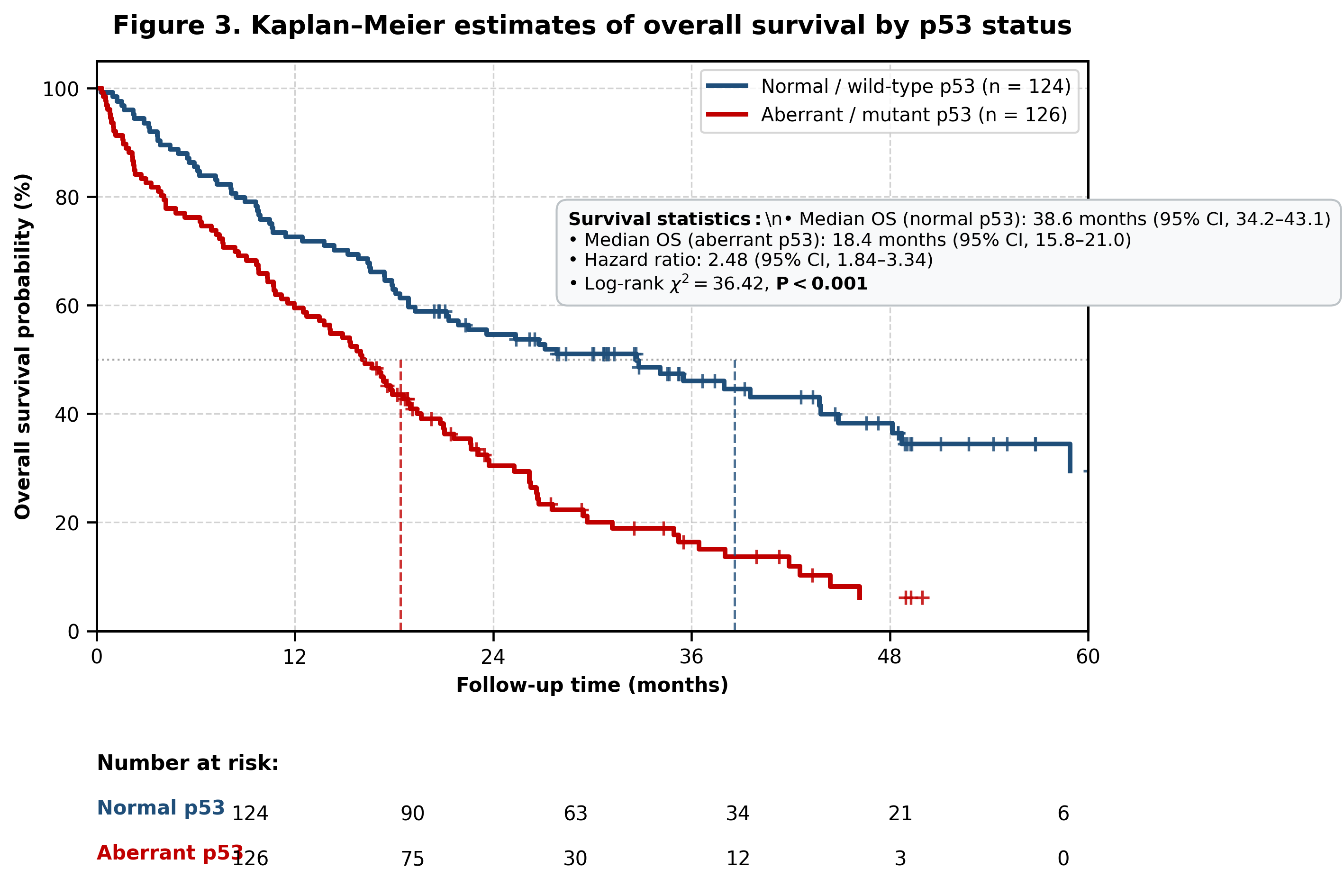
Results: Aberrant p53 expression (86.2% in TNBC, P<0.001) significantly correlates with aggressive metastatic organotropism, notably visceral involvement (41.3% vs. 14.5%, P<0.001). Median overall survival was markedly reduced in patients with aberrant p53 (18.4 vs. 38.6 months, P<0.001). Multivariate analysis confirmed p53 deregulation as a potent, independent prognostic determinant for mortality (aHR = 2.30, 95% CI: 1.75–3.10, P<0.001), surpassing conventional clinical biomarkers in predicting adverse outcomes in metastatic breast malignancy.

Conclusion: This study identifies p53 functional alteration as a critical independent prognostic biomarker for metastatic breast cancer, driving aggressive visceral dissemination and accelerated mortality. These data indicate that p53 status is a more potent survival determinant than standard clinicopathological markers.

Graphical Abstract

Prognostic Significance of p53 Alterations within the Biomarker Profile of Patients with Metastatic Breast Cancer

Keywords

Subjects

[1]    Bray, F., Ferlay, J., Soerjomataram, I., Siegel, R. L., Torre, L. A., & Jemal, A. (2018). Global cancer statistics 2018: GLOBOCAN estimates of incidence and mortality worldwide for 36 cancers in 185 countries. CA: A Cancer Journal for Clinicians, 68(6), 394–424.
[2]    Park, S., Han, W., Kim, J., Kim, M. K., Lee, E., Yoo, T. K., Lee, H. B., Kang, Y. J., Kim, Y. G., Moon, H. G., & Noh, D. Y. (2015). Risk factors associated with distant metastasis and survival outcomes in breast cancer patients with locoregional recurrence. Journal of Breast Cancer, 18(2), 160–166.
[3]    Jeong, Y., Kim, S. S., Gong, G., Lee, H. J., Ahn, S. H., Son, B. H., Lee, J. W., Choi, E. K., Lee, S. W., & Ahn, S. D. (2015). Prognostic factors for distant metastasis in patients with locoregional recurrence after mastectomy. Journal of Breast Cancer, 18(3), 279–284.
[4]    Bamford, S., Dawson, E., Forbes, S., Clements, J., Pettett, R., Dogan, A., Flanagan, A., Teague, J., Futreal, P. A., Stratton, M. R., & Wooster, R. (2004). The COSMIC (Catalogue of Somatic Mutations in Cancer) database and website. British Journal of Cancer, 91(2), 355–358.
[5]    Rimawi, M. F., De Angelis, C., Contreras, A., Pareja, F., Geyer, F. C., Burke, K. A., Herrera, S., Wang, T., Mayer, I. A., Forero, A., Nanda, R., Goetz, M. P., Chang, J. C., Krop, I. E., Wolff, A. C., Pavlick, A. C., Fuqua, S. A. W., Gutierrez, C., Hilsenbeck, S. G., Li, M. M., et al. (2018). Low PTEN levels and PIK3CA mutations predict resistance to neoadjuvant lapatinib and trastuzumab without chemotherapy in patients with HER2 over-expressing breast cancer. Breast Cancer Research and Treatment, 167(3), 731–740.
[6]    Hyman, D. M., Smyth, L. M., Donoghue, M. T. A., Westin, S. N., Bedard, P. L., Dean, E. J., Bando, H., El-Khoueiry, A. B., Pérez-Fidalgo, J. A., Mita, A., Schellens, J. H. M., Chang, M. T., Reichel, J. B., Bouvier, N., Selcuklu, S. D., Soumerai, T. E., Torrisi, J., Erinjeri, J. P., Ambrose, H., et al. (2017). AKT inhibition in solid tumors with AKT1 mutations. Journal of Clinical Oncology, 35(20), 2251–2259.
[7]    Smyth, L. M., Tamura, K., Oliveira, M., Ciruelos, E. M., Mayer, I. A., Sablin, M. P., Biganzoli, L., Ambrose, H. J., Ashton, J., Barnicle, A., Cashell, D. D., Corcoran, C., de Bruin, E. C., Foxley, A., Hauser, J., Lindemann, J. P. O., Maudsley, R., McEwen, R., Moschetta, M., et al. (2020). Capivasertib, an AKT kinase inhibitor, as monotherapy or in combination with fulvestrant in patients with AKT1 E17K-mutant, ER-positive metastatic breast cancer. Clinical Cancer Research, 26(15), 3947–3957.
[8]    Smyth, L. M., Zhou, Q., Nguyen, B., Yu, C., Lepisto, E. M., Arnedos, M., Hasset, M. J., Lenoue-Newton, M. L., Blauvelt, N., Dogan, S., Micheel, C. M., Wathoo, C., Horlings, H., Hudecek, J., Gross, B. E., Kundra, R., Sweeney, S. M., Gao, J., Schultz, N., et al. (2020). Characteristics and outcome of AKT1 E17K-mutant breast cancer defined through AACR Project GENIE, a clinicogenomic registry. Cancer Discovery, 10(4), 526–535.
[9]     Mokabber, N, Mokaber, M and Lotfi, A R. (2026). Effects of Dexmedetomidine on the Incidence of Agitation and Pain Severity after Traumatic Nasal Surgeries. Medicinal, Psychological, and Health Research Journal (MPHRJ), 2(6), 452-460.
[10]  Schmid, P., Abraham, J., Chan, S., Wheatley, D., Brunt, A. M., Nemsadze, G., Baird, R. D., Park, Y. H., Hall, P. S., Perren, T., Stein, R. C., Mangel, L., Ferrero, J. M., Phillips, M., Conibear, J., Cortes, J., Foxley, A., de Bruin, E. C., McEwen, R., et al. (2020). Capivasertib plus paclitaxel versus placebo plus paclitaxel as first-line therapy for metastatic triple-negative breast cancer: The PAKT trial. Journal of Clinical Oncology, 38(5), 423–433.
[11] Kim, S. B., Dent, R., Im, S. A., Espie, M., Blau, S., Tan, A. R., Isakoff, S. J., Oliveira, M., Saura, C., Wongchenko, M. J., Masuda, N., … et al. (2017). Ipatasertib plus paclitaxel versus placebo plus paclitaxel as first-line therapy for metastatic triple-negative breast cancer (LOTUS): A multicentre, randomised, double-blind, placebo-controlled, phase 2 trial. The Lancet Oncology, 18(10), 1360–1372.
[12] Hessam, R and Milanifard, M. (2026). Clinical Performance of Wearable and Continuous Vital Sign Monitoring Technologies in Emergency Department Patients: A Systematic Review and Meta-analysis. Medicinal, Psychological, and Health Research Journal (MPHRJ), 2(6), 461-471.
[13] Aghili, A and Najafi, S. (2026). Effectiveness of Antibiotic Prophylaxis in Preventing Postoperative Infection Following Total Knee Arthroplasty: A Systematic Review. Medicinal, Psychological, and Health Research Journal (MPHRJ), 2(6), 429-437.
[14]  Robson, M. E., Tung, N., Conte, P., Im, S. A., Senkus, E., Xu, B., Masuda, N., Delaloge, S., Li, W., Armstrong, A., Wu, W., Goessl, C., Runswick, S., & Domchek, S. M. (2019). OlympiAD final overall survival and tolerability results: Olaparib versus chemotherapy treatment of physician’s choice in patients with a germline BRCA mutation and HER2-negative metastatic breast cancer. Annals of Oncology, 30(4), 558–566.
[15] Litton, J. K., Rugo, H. S., Ettl, J., Hurvitz, S. A., Gonçalves, A., Lee, K. H., Fehrenbacher, L., Yerushalmi, R., Mina, L. A., Martin, M., Roché, H., Im, Y. H., Quek, R. G. W., Markova, D., Tudor, I. C., Hannah, A. L., Eiermann, W., & Blum, J. L. (2018). Talazoparib in patients with advanced breast cancer and a germline BRCA mutation. New England Journal of Medicine, 379(8), 753–763.
[16] Tung, N. M., Robson, M. E., Ventz, S., Santa-Maria, C. A., Nanda, R., Marcom, P. K., Shah, P. D., Ballinger, T. J., Yang, E. S., Vinayak, S., Melisko, M., Brufsky, A., DeMeo, M., Jenkins, C., Domchek, S., D’Andrea, A., Lin, N. U., Hughes, M. E., Carey, L. A., et al. (2020). TBCRC 048: Phase II study of olaparib for metastatic breast cancer and mutations in homologous recombination-related genes. Journal of Clinical Oncology, 38(36), 4274–4282.
[17] Meric-Bernstam, F., Zheng, X., Shariati, M., Damodaran, S., Wathoo, C., Brusco, L., Demirhan, M. E., Tapia, C., Eterovic, A. K., Basho, R. K., Ueno, N. T., Janku, F., Sahin, A., Rodon, J., Broaddus, R., Kim, T. B., Mendelsohn, J., Mills Shaw, K. R., Tripathy, D., et al. (2018). Survival outcomes by TP53 mutation status in metastatic breast cancer. JCO Precision Oncology, 2, 1–15.
[18] Yates, L. R., Knappskog, S., Wedge, D., Farmery, J. H. R., Gonzalez, S., Martincorena, I., Alexandrov, L. B., Van Loo, P., Haugland, H. K., Lilleng, P. K., et al. (2017). Genomic evolution of breast cancer metastasis and relapse. Cancer Cell, 32(2), 169–184.e7.
[19] Robinson, D. R., Wu, Y. M., Vats, P., Su, F., Lonigro, R. J., Cao, X., Kalyana-Sundaram, S., Wang, R., Ning, Y., Hodges, L., Gursky, A., Siddiqui, J., Tomlins, S. A., Roychowdhury, S., Pienta, K. J., Kim, S. Y., Roberts, J. S., Rae, J. M., Van Poznak, C. H., et al. (2013). Activating ESR1 mutations in hormone-resistant metastatic breast cancer. Nature Genetics, 45(12), 1446–1451.
[20] Fujii, T., Matsuda, N., Kono, M., Harano, K., Chen, H., Luthra, R., Roy-Chowdhuri, S., Sahin, A. A., Wathoo, C., Joon, A. Y., Tripathy, D., Meric-Bernstam, F., & Ueno, N. T. (2018). Prior systemic treatment increased the incidence of somatic mutations in metastatic breast cancer. European Journal of Cancer, 89, 64–71.
[21] Jeselsohn, R., Yelensky, R., Buchwalter, G., Frampton, G., Meric-Bernstam, F., Gonzalez-Angulo, A. M., Ferrer-Lozano, J., Perez-Fidalgo, J. A., Cristofanilli, M., Gomez, H., Arteaga, C. L., Giltnane, J., Balko, J. M., Cronin, M. T., Jarosz, M., Sun, J., Hawryluk, M., Lipson, D., Otto, G., et al. (2014). Emergence of constitutively active estrogen receptor-alpha mutations in pretreated advanced estrogen receptor-positive breast cancer. Clinical Cancer Research, 20(7), 1757–1767.
[22] Andreano, K. J., Baker, J. G., Park, S., Safi, R., Artham, S., Oesterreich, S., Jeselsohn, R., Brown, M., Sammons, S., Wardell, S. E., Chang, C. Y., Norris, J. D., & McDonnell, D. P. (2020). The dysregulated pharmacology of clinically relevant ESR1 mutants is normalized by ligand-activated WT receptor. Molecular Cancer Therapeutics, 19(7), 1395–1405.
[23] Keene, K. S., King, T., Hwang, E. S., Peng, B., McGuire, K. P., & Tapia, C. (2018). Molecular determinants of post-mastectomy breast cancer recurrence. npj Breast Cancer, 4, Article 34.
[24] Chen, K., Meric-Bernstam, F., Zhao, H., Zhang, Q., Ezzeddine, N., Tang, L. Y., Qi, Y., Mao, Y., Chen, T., Chong, Z., Zhou, W., Zheng, X., Johnson, A., Aldape, K. D., Routbort, M. J., Luthra, R., Kopetz, S., Davies, M. A., de Groot, J., et al. (2015). Clinical actionability enhanced through deep targeted sequencing of solid tumors. Clinical Chemistry, 61(3), 544–553.
[25] Meric-Bernstam, F., Johnson, A., Holla, V., Bailey, A. M., Brusco, L., Chen, K., Routbort, M., Patel, K. P., Zeng, J., Kopetz, S., Davies, M. A., Piha-Paul, S. A., Hong, D. S., Eterovic, A. K., Tsimberidou, A. M., Broaddus, R., Bernstam, E. V., Shaw, K. R., Mendelsohn, J., & Mills, G. B. (2015). A decision support framework for genomically informed investigational cancer therapy. Journal of the National Cancer Institute, 107(7), Article djv098.
[26] Kurnit, K. C., Dumbrava, E. E. I., Litzenberger, B., Khotskaya, Y. B., Johnson, A. M., Yap, T. A., Rodon, J., Zeng, J., Shufean, M. A., Bailey, A. M., Sánchez, N. S., Holla, V., Mendelsohn, J., Shaw, K. M., Bernstam, E. V., Mills, G. B., & Meric-Bernstam, F. (2018). Precision oncology decision support: Current approaches and strategies for the future. Clinical Cancer Research, 24(12), 2719–2731.
[27] Johnson, A., Khotskaya, Y. B., Brusco, L., Zeng, J., Holla, V., Bailey, A. M., Litzenburger, B. C., Sánchez, N. S., Shufean, M. A., Piha-Paul, S., Subbiah, V., Hong, D., Routbort, M., Broaddus, R., Mills Shaw, K. R., Mills, G. B., Mendelsohn, J., & Meric-Bernstam, F. (2017). Clinical use of precision oncology decision support. JCO Precision Oncology, 1, 1–12.
[28] Gonzalez-Angulo, A. M., Hennessy, B. T., Meric-Bernstam, F., Sahin, A., Liu, W., Ju, Z., Carey, M. S., Davies, M. A., and others. (2011). Functional proteomics can define prognosis and predict pathologic complete response in patients with breast cancer. Clinical Proteomics, 8(1), Article 11.
[29] Meric-Bernstam, F., Akcakanat, A., Chen, H., Sahin, A., Tarco, E., Carkaci, S., Adrada, B. E., Singh, G., Do, K. A., Garces, Z. M., Mittendorf, E. A., Babiera, G., Bedrosian, I., Hwang, R., Krishnamurthy, S., Symmans, W. F., Gonzalez-Angulo, A. M., & Mills, G. B. (2014). Influence of biospecimen variables on proteomic biomarkers in breast cancer. Clinical Cancer Research, 20(14), 3870–3883.
[30] Li, H., & Durbin, R. (2009). Fast and accurate short read alignment with Burrows-Wheeler transform. Bioinformatics, 25(14), 1754–1760.
[31] DePristo, M. A., Banks, E., Poplin, R., Garimella, K. V., Maguire, J. R., Hartl, C., Philippakis, A. A., del Angel, G., Rivas, M. A., Hanna, M., McKenna, A., Fennell, T. J., Kernytsky, A. M., Sivachenko, A. Y., Cibulskis, K., Gabriel, S. B., Altshuler, D., & Daly, M. J. (2011). A framework for variation discovery and genotyping using next-generation DNA sequencing data. Nature Genetics, 43(5), 491–498.
[32] Lonigro, R. J., Grasso, C. S., Robinson, D. R., Jing, X., Wu, Y. M., Cao, X., Quist, M. J., Tomlins, S. A., Pienta, K. J., & Chinnaiyan, A. M. (2011). Detection of somatic copy number alterations in cancer using targeted exome capture sequencing. Neoplasia, 13(11), 1019–1025.